Three Dog Night

And day too.  Buddy and Pip have been visiting, and will be heading home tomorrow. Rotating through three dogs has kept us rather busy. Pax and Pip need separate times and places because Pip keeps coming at Pax for some roughhousing fun, and Pax can be a bit brusque in telling her to bugger off.

IMAGE.JPG

Then, this evening attendance at the League of Women Voters annual awards banquet at which friend and neighborhood association co-conspirator, James, received a democracy award.

IMAGE.JPG

Making Ice?

Possibly, if the wind ever quits.  

Cookout

Cookout

Walnuts on the table

Walnuts on the table

Conditions this morning on our walk through the park conducive to watery eyes and drippy noses—thankful for mittens rather than gloves. Above freezing for a bit in the afternoon, but, with a clear sky, dropping well below tonight. And the wind finally seems to be subsiding. The recipe for ice is calm with cold, so we may see some forming.

And, possibly the first race of the season next weekend, on Lake Puckaway, sponsored by the Puckaway Ice Sailing Society, or....for short.

Freakish Weather

Sixty five, with fifty mph wind gusts, rain squalls, and thunderstorms—winter supposedly arriving later tonight.

Day spent down south, with Sue helping Jayne, and me helping Irene install shelving and and hangers, and then beginning the organization of her new garage. Thai takeaway for dinner. At dinner Irene brought out a few relic photos she uncovered in her move (from 1977).

SueIrene.jpg
JBNFlorida.jpg
JBNGullsFlorida.jpg

Writer’s Block

It is hard sometimes to come up with things of substantial significance, especially when not much of significance happens.  

IMAGE.JPG

We did have a good dinner last night—chicken with lemon over maple syrup enhanced home-grown squash.

Another repeat of the weather pattern—cold last night under a clear sky, warming into the 50s by afternoon. The forecast, however, has the pattern finally breaking.

Bright super moon in the backyard.  


FullSizeRender.jpg

The Glass Remains High...

...and the pattern holds—cool nights, pleasant days, with no sign of winter. Good for bike riding.

Shagbark

Shagbark

 When the Winter Chrysanthemums Go

by Matsuo Basho

When the winter chrysanthemums go,
there's nothing to write about
but radishes.

```````

by JBN

When the autumn hydrangeas go, 
there’s nothing to write about
but lack of snow.  

~~~~~~~

Recommend Radio Free Vermont, by climate activist and founder of 350.org, Bill McKibben. Quick, fun "eco-activism" novel, in the vein of Edward Abbey's Monkey Wrench Gang.

Pax’s Prairie

Another cloudless, unseasonably pleasant day.

FullSizeRender.jpg

~~~~~~~~~~~~~~~~
Pax’s Prairie

     You can get lost in a prairie. Well, Pax can’t because he can “see” with his nose, and being in very tall grass does not inconvenience him. But I could get lost if this prairie were just a little bigger and I wandered off the paths. Early settlers to this part of the world sometimes did get lost on the tall grass prairie, the sea of grass, and had to be careful. If you were in the thick of it, you had to be up on a big horse to see over the top to where you wanted to go.
     Pax and I like being within walking distance of a real prairie, and we like walking through it (mostly on the paths) and around it. From the top of the ridge left by the glacier 12,000 years ago it’s a wide open space with a marsh in the low part. No trees except a few burr oaks here and there. If you took 120 football fields and stuck them all together that would be about the size of it. 
     While it feels rather big, our prairie is really just a remnant, a little scrap of what used to be. Back before European settlement, the whole middle part of North America was prairie—from Indiana to Colorado, from Texas into Canada. People who saw it for the first time just about fell off their horses—they’ed never seen anything like it.
     Who ever heard of grass seven feet tall, or saw the wind sending waves of color across miles of flowers?
     The prairie biome is a unique one, caused some by climate but more by fire. Prairies like fire. Almost all prairie plants are perennials and have very deep roots. In the fall, after the seeds are dispersed, all the dry vegetation above ground becomes tinder. Once a fire gets started, it burns hot and quick, and depending on the wind, can move fast—faster than a person can walk. But this fire doesn’t bother prairie plants at all since their essential parts are below ground, sometimes extending down twelve or more feet.
     All that’s left after a fire are cinders and blackened stubble. Any invading species that don’t have prairie-style roots, and any tree saplings, are toast. But come spring rain, the deep prairie roots send up new shoots, and within a few months the prairie is back better than ever and tall enough to get lost in. If it weren’t for fire most prairie would eventually turn into forest.
     Lightning sometimes starts prairie fires, but actually Native Americans were responsible for much of it. They would have “fire hunts” in which they would “set fire to the grass everywhere around a herd of bison except some passage which they leave on purpose and where they take post with their bows and arrows.” (said Father Louis Hennepin in 1680)
     Tall grass prairie is called tall grass because of all the tall grass, but a prairie is really a mix of grass and other kinds of plants called forbs. Forbs are non-woody, broad-leaved plants with flowers, and there are hundreds of different kinds in a healthy prairie. Some forb or other is always in flower—from earliest spring until hard frost—with blooms of yellow, blue, pink, lavender, indigo, coral, gold, magenta, crimson, and orange.
     One interesting forb is rattlesnake master, which has spiky, white globes for flowers. Supposedly a decoction of leaves and roots is useful in treating snakebite. Some folks claim that snakes avoid areas with rattlesnake master, while others claim that if you see the plant you need to watch your step to avoid getting bit.
     Another broad-leaved member of the prairie is the compass-plant. It has a big yellow flower on a long stalk that towers as high as ten feet. It’s called the compass-plant because most of the time the flat part of its big leaves face east and west while the narrow blade part points north and south. This is handy if you tend to get lost.
     Well, I’d better stop writing, The afternoon sun is getting low, and Pax, who always knows what time it is, is poking me with his nose. This means—time to go for our prairie walk.

PrairiePlants.jpg


Running Low...

...on daylight.  

IMAGE.JPG

Seem to have fallen into the assumption that most forms of productivity need to be accomplished in daylight, and that the dark hours are for things like contemplation, reading, watching episodes, and reading. With daylight diminishing toward nine hours out of twenty-four, not much is getting done except expansion of the "to-do" list. I asked Pax if he was willing to cut back on outdoor time now that we were getting close to the winter solstice, but he declined. I appreciate where he's coming from. 

This and That

Another warm day, perfect for iceboat trailer refinements and other pre-Xmas activity. 

IMAGE.JPG

Neighbor across the street has spent the past two evenings grinding up the thick carpet of leaves dropped by his old, front-yard silver maple. While this neighbor only comes out at dusk, he seems to have pretty well completed the job, which means his leaves will no longer be our leaves. This is quite different from the year when, on a very windy day, he used his rake to fling piles high into the scattering breeze.

But, hey, we live in a neighborhood and that means neighbors.

It’s a Pretty Simple Platform...

...so let’s use it.  

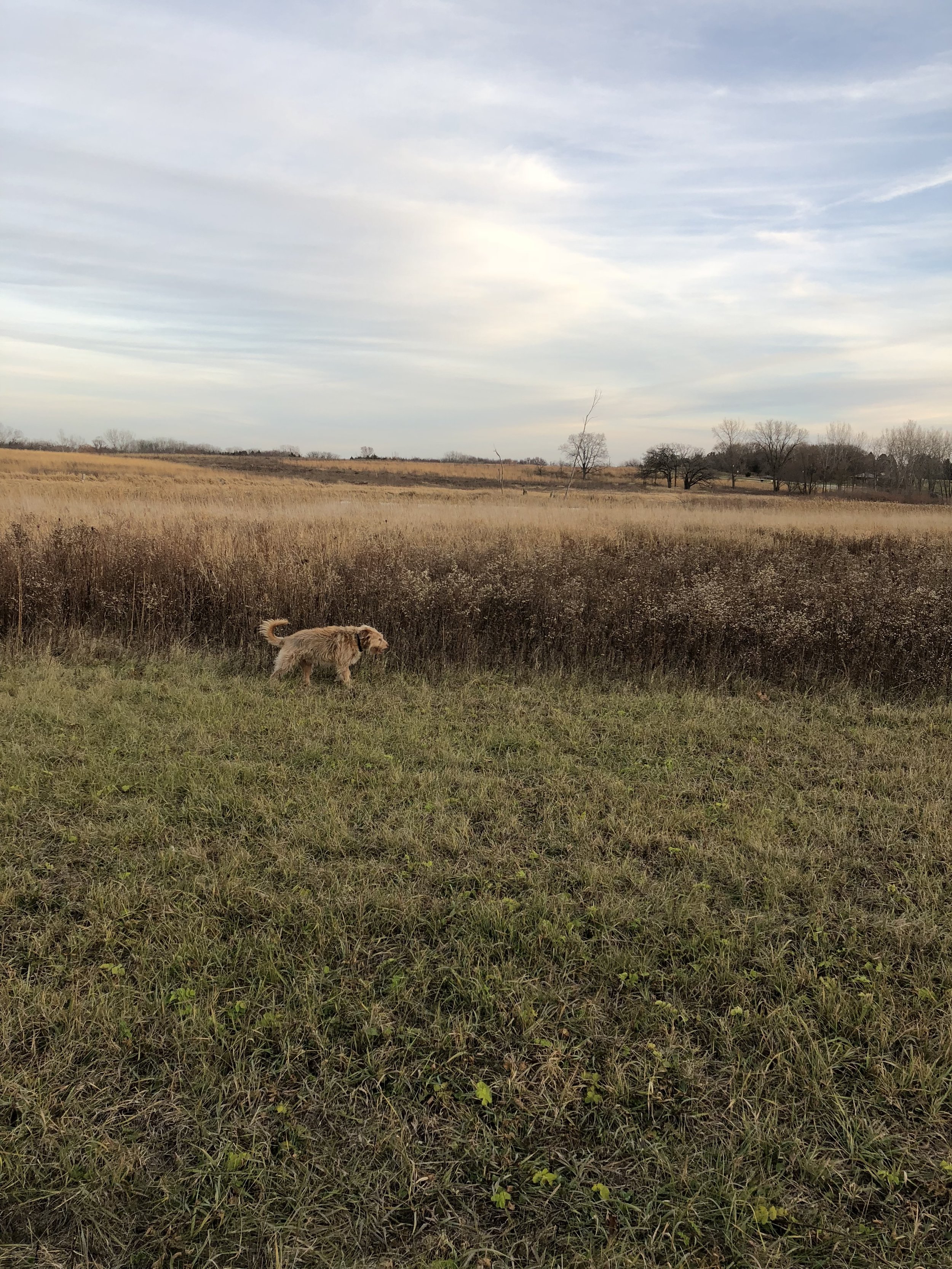
Pax prowling prairie.

Pax prowling prairie.

Paul Krugman, economist, professor, and NYTimes columnist, posted a Thanksgiving column called, "On Feeling Thankful But Fearful." The column inspired lots of other people to contribute their thoughts along similar lines. (And with NYT, as I've said before, the comments are often as good as the column.) Below are two, which  I think come close to the mark—only missing is the idea of national service, in the footsteps of the Civilian Conservation Corps(CCC).

John Babson, Hong Kong
In terms of privilege and opportunity I share so very much the observations and sentiments reflected here by Paul Krugman. Indeed I am very thankful. Having sensed some of this while young, I started my career as a U.S. Army Officer. That experience taught me that in a democracy such as ours, the first line of defense is not the military but education.
Harrison Howard, Manhattan's Upper West Side
In addition to defending the gains of the recent past, we should support (1) the transition in coal country to green and other jobs, (2) the coordination of corporations with community college students to smooth their path to employment, (3) the ongoing training of people already employed to increase their flexibility in a world that is in ever greater flux, (4) new trade pacts in which labor leaders have a seat at the negotiating table and specific guarantees of the environment and labor rights are hammered out, (5) increased government aid to college students for tuition, room and board, (6) a massive infrastructure program to be carried out over a ten year period and which would include the modernization of our urban water systems, (7) a tax reform that would help reverse the thirty year trend of growing income and property inequality but would also simultaneously address the problem of the long term deficit, (8) comprehensive immigration reform, (9) public financing of national and presidential elections, (10) redistricting of election districts by nonpartisan commissions, and(11) a gradualist plan towards universal health care. These measures could support the principles of equality of opportunity and self reliance.

Iceboats On The Asphalt...

...which may seem odd, but really is quite necessary.  Especially when there's a new boat in the fleet. A missing pin here, the wrong kind of bolt there, shrouds too slack, runners out of alignment—and that sort of thing, Fix it now, or miss the first day or two of sailing, which in iceboating may be the only days of sailing.

And it's difficult to do this sort of thing this time of year. Today, although the weather was mild, the amount of daylight was decidedly limited.

IMAGE.JPG
IMAGE.JPG

There are lots of variables in iceboating—mast rake, shroud tension, mast bend, runner alignment, runner sharpness, plank flexion, sail cut, batten tension, race weight—not to mention the cut of your jib. So it does behoove one to get set up ahead of time.